The Generalist Trap: Why I Felt Like a “Professional Beginner”
- March 30, 2026
- 5 min read
- Engineering career
Table of Contents
Recently, I noticed something unsettling about the technologies I work with.
Not because of a single project. It happened gradually, across several projects over time. Each one added a few tools to the stack.
At some point I stepped back and looked at the list.
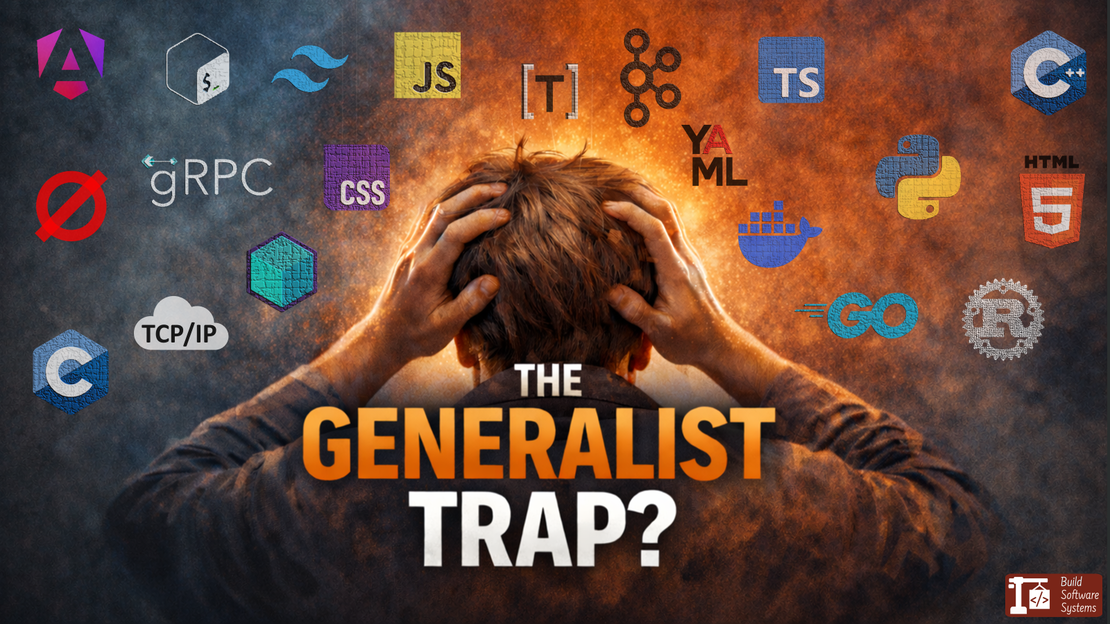
- Infrastructure & Observability tools like Docker, Kubernetes, Helm and Grafana.
- Languages such as Go, C/C++, Python, JavaScript, TypeScript, Rust and Bash.
- Messaging systems like Kafka and ZeroMQ, and RPC frameworks like gRPC (Protobuf).
- Networking topics like TCP/IP and Linux internals.
- Some frontend work with Angular, Tailwind, Ionic, HTML, and CSS.
- Testing and architecture practices, using tools like Testcontainers to manage integration environments, while navigating Microservices, Event-Driven Design, and Clean Architecture patterns.
- And of course the glue that holds everything together: configuration files. Mostly YAML. Sometimes TOML.
None of this is unusual. Modern systems need many of these pieces. But after a while, a pattern started to emerge. Within a relatively short period of time, I had touched many of them.
Why I Liked Being a Generalist
At first, I genuinely enjoyed this variety.
I liked being able to move across the stack. If something broke in the deployment pipeline, I could dig into Kubernetes manifests. If a service behaved strangely, I could read or patch the Go code. I could set up Grafana dashboards to understand what was happening in the system.
I wrote Kafka producers and consumers to connect services together, and built services across different languages when needed.
Over time, this builds a mental map of how the system fits together.
I was also involved in projects that were quite different from each other: working on a C project, then switching to Python or JavaScript on another. Sometimes I was discussing the architecture of a new system; other times I was making changes to Helm charts.
For a long time, I liked being the person who could jump between these layers, a kind of Swiss Army knife engineer. Not the deepest expert in every tool, but someone who could help in many situations.
For a while, that felt like a strength.
Where Generalism Started to Break Down
Over time, I started noticing something else.
Kubernetes alone can take years to understand well. The same is true for networking, operating systems, distributed messaging, or modern frontend frameworks.
But my work kept moving between them. I would learn just enough to solve the problem in front of me. Then the project would shift, or another issue would appear somewhere else in the system.
After a few years, I realized I had seen many technologies, but rarely stayed with one long enough to go deep.
That is when the strange feeling appeared. I was not a beginner anymore. But I did not feel like an expert either. Instead, I felt like a professional beginner across many tools and concepts.
I could make things work. But I rarely reached the point where I truly understood the deeper patterns or the more elegant solutions.
And without that depth, some of the curiosity started to fade.
Why This Happens
The issue is not just complexity. It is how the work is structured. Many projects reward quick results over deep understanding. You learn just enough to solve the problem, then move on to the next tool, the next system, the next fire to put out.
But real systems connect all of these layers, and many engineers move between them regularly.
Infrastructure alone spans containers, orchestration, networking, observability, and deployment pipelines. Each of these areas can be a career on its own. Then there are languages, frameworks, databases, messaging systems, and frontend tools.
That creates a constant tension between breadth and depth.
Ways People Deal With It
Over time, I have seen a few different approaches.
Some engineers choose to specialize. They focus on a specific domain and invest deeply in it: distributed systems, networking, infrastructure, or language runtimes. They still understand the rest of the stack, but most of their effort goes into one area.
Others focus on principles rather than tools. Tools and frameworks change quickly, but fundamentals tend to last. Concepts from networking, operating systems, and system design carry across many technologies. In that approach, tools are something you learn when needed, not something you try to master completely.
A third path often appears later in a career. Some engineers move toward roles where breadth is the point (technical leads, architects, or staff engineers). Their work is less about mastering a specific tool and more about understanding how systems fit together and making the right trade-offs.
Where I Currently Stand
I no longer try to go deep on everything I touch. That usually means accepting that some parts of the system will remain shallow for me, and that is a trade-off.
Instead, I focus on keeping strong fundamentals and choosing a few areas where I go deeper. The rest are tools I use when I need them, and try to master the ones I find most interesting.
Otherwise, it is easy to drift back into being a professional beginner.
Newsletter
Subscribe to our newsletter and stay updated.
A Question For Other Engineers
If you have been in this field for a while, you have probably felt this tension.
Too many tools and technologies. Not enough time to master them.
How did you deal with it?
Did you specialize in a domain? Did you focus on principles instead of tools? Or did you move toward roles where variety is the job?
I would be curious to hear how others navigated this tension over time.