Boolean Semantics Across 50+ Programming Languages: Strict Typing vs Implicit Coercion
- August 24, 2026
- 16 min read
- Programming concepts
Table of Contents
When I first moved from C to Python, I was surprised by how many different values could be used in a condition. Lists, strings, dictionaries, and even class instances were all accepted in a boolean context.
1class MyObject:
2  pass
3
4if [1,2,3] or {"a": 1} or "Hello" or 0 or None or MyObject():
5    print("This is Python")
What surprised me even more is that the same idea is rejected in another scripting language such as R:
1if (list(1, 2, 3)) {
2  cat("This is R\n")
3}
Output:
Error in if (list(1, 2, 3)) { : the condition has length > 1
Execution halted
That contrast is not unusual. Across languages, the rules for what is acceptable in an if condition vary a lot.
Some languages are strict and require an explicit boolean. Others accept numbers, objects, or collections with little or no complaint.
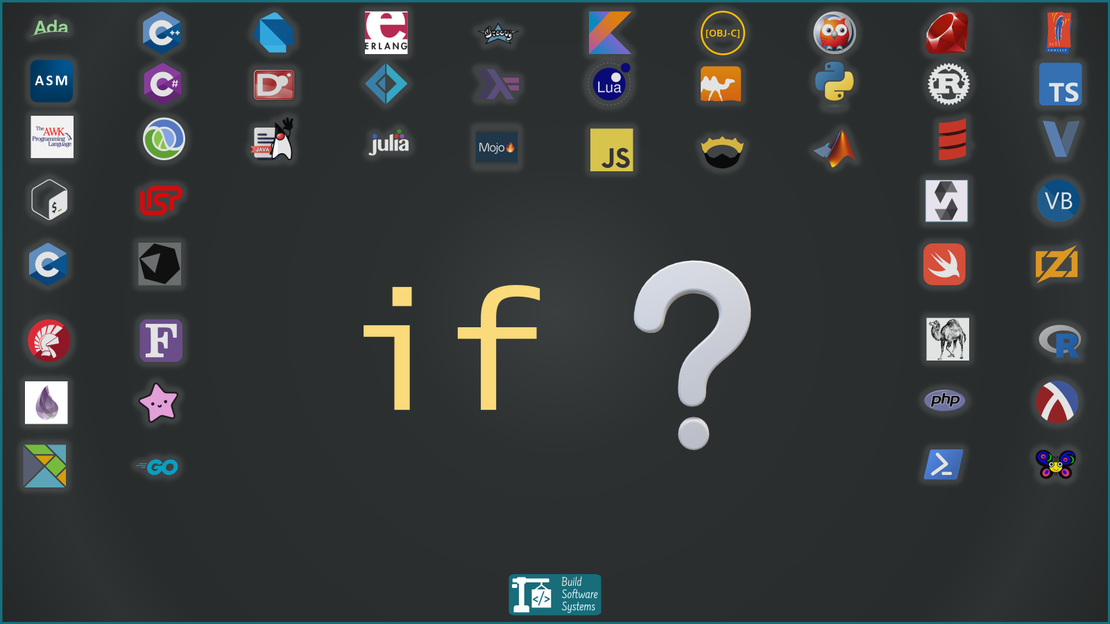
I decided to look at how 50+ popular programming languages handle boolean contexts and compare the patterns. The result is a surprisingly consistent lesson: language design is doing a lot of work here.
The stricter the language, the more it pushes the programmer toward explicit intent. The looser the language, the more concise the code can feel, but the easier it is to overlook an edge case.
This article walks from the strictest systems to the loosest ones, then closes with a quick reference chart.
How Are They Mapped to Boolean?
At the hardware level, a boolean is just a bit: 0 (false) or 1 (true).
The interesting part is how each language maps its own types to that bit.
Some languages require an explicit boolean value. Others allow numbers, objects, or even collections to be accepted in a boolean context.
This mapping is where language design philosophies diverge:
- Strict languages force clarity and prevent ambiguity
- Loose languages favor conciseness and flexibility
What looks like a small detail — “what can be used in an if” — is actually a reflection of a language’s philosophy.
Strict languages optimize for correctness.
Loose languages optimize for development speed and expressiveness.
And everything in between is a trade-off.
In this article, we focus on what can be used in a boolean context, not yet on which values are truthy or falsy in detail (that’s a separate deep dive).
Info
This article is about what a language accepts in a boolean context, not about the exact truth table for each value.
It also ignores the separate case of multiple Boolean types, such as the Boolean, ByteBool, WordBool, and LongBool family in Delphi/Objective Pascal.
Strict Boolean Only
Some languages refuse to guess.
In languages like Go, Fortran, and Rust, a condition must evaluate to a boolean value — and nothing else. There is no automatic conversion from numbers, strings, or collections. This means you must always write the exact condition you intend to check.
Trying to use anything else (like 0, "", or a collection) results in a compile-time error.
1if 1 { }        // ❌ compile error
2if true { }     // ✅ valid
Instead of relying on implicit behavior (like “empty ⟶ false” or “non-zero ⟶ true”), you make it explicit:
 1let my_list = vec![1, 2, 3];
 2let my_map = HashMap::from([("a", 1)]);
 3let my_str = "Hello";
 4let my_num = 0;
 5let my_opt: Option<i32> = None;
 6
 7if !my_list.is_empty()
 8    || !my_map.is_empty()
 9    || !my_str.is_empty()
10    || my_num != 0
11    || my_opt.is_some()
12{
13    println!("This is Rust: Explicit conditions only.");
14}
Each part clearly answers a specific question:
- Is the list empty?
- Is the map empty?
- Is the string empty?
- Is the number non-zero?
- Does the option contain a value?
There’s no hidden logic and no need to remember language-specific coercion rules.
Tip
The benefit is clarity: the code states the intent directly, and you do not need a mental model of special-case coercion rules. The cost is verbosity, since every condition must be written explicitly.
Other languages in this category are: Ada, Dart (>= 2.0), Elm, Gleam, F#, Julia, Haskell, Kotlin, OCaml, Delphi/Objective Pascal, Solidity, Swift, V, Zig
Strict… Until It Isn’t
Java appears to follow the same model as strict languages:
A condition must evaluate to a boolean, nothing else.
1if (1) { }       // ❌ compile error
2if (null) { }    // ❌ compile error
3if (true) { }    // ✅ valid
There is no implicit conversion from numbers, strings, or objects.
However, Java introduces a subtle exception through its Boolean wrapper type.
Java allows implicit unboxing from Boolean to boolean primitive:
1Boolean flag = Boolean.TRUE;
2
3if (flag) { }    // ✅ works (auto-unboxed to boolean)
This looks just as strict, but there’s hidden edge case.
1Boolean flag = null;
2
3if (flag) { }    // 💥 NullPointerException
The code compiles because flag is a Boolean class object.
But fails at runtime: unboxing a null Boolean value throws a NullPointerException, breaking the condition.
To write safe code, you must be explicit:
1if (Boolean.TRUE.equals(flag)) { }
or
1if (flag != null && flag) { }
Warning
Java enforces boolean conditions at compile time, but the boxed Boolean type can still be null.
That makes implicit unboxing a runtime trap if you are not careful.
Controlled Boolean Context Semantics
C#, Scala, and Nim remain strict by default: A condition must evaluate to a boolean, with no implicit conversion from numbers or objects.
1if (1) { } // ❌ compile error
However, they introduce controlled ways to customize how values behave in conditions.
Instead of built-in truthiness, developers can define how custom types behave in conditional expressions.
C#: Local and Explicit
In C#, types can define their behavior in conditions
by implementing the true and false operators.
 1public struct MyType
 2{
 3    public int Value;
 4
 5    public static bool operator true(MyType x) => x.Value > 0;
 6    public static bool operator false(MyType x) => x.Value <= 0;
 7}
 8
 9MyType x = new MyType { Value = 10 };
10
11if (x) { }      // ✅ allowed
- 👉 Key idea:
- This behavior is opt-in and local to the type.
It does not affect built-in types like
int. - You always know where the behavior comes from.
Scala and Nim: Global and Implicit
Scala and Nim take a more flexible approach. They allow defining conversions that make other types usable in conditions.
Scala example:
1implicit def intToBoolean(x: Int): Boolean = x != 0
2//// Or this (scala 3)
3//given Conversion[Int, Boolean] with
4//  def apply(i: Int): Boolean = i != 0
5
6if (1) { }      // ✅ allowed
Nim example:
1converter stringToBool(s: string): bool = s.len > 0
2
3if "hello":     # ✅ allowed
4  echo "non-empty string"
- 👉 Key idea:
- This is global and implicit. Once defined, it can affect how primitives behave across the codebase.
The Trade-off
Both approaches introduce flexibility, but in very different ways:
- C# → explicit, local, predictable
- Scala and Nim → implicit, global, more powerful (but easier to misuse)
Neither is as permissive as the dynamic languages discussed later, but both move away from strict boolean-only conditions.
Numeric & Coercion Systems
C, C++, and Visual Basic, treat conditions as a direct check over raw scalar values: numbers, characters, and pointers are accepted as condition operands, and the language does not require an explicit boolean expression.
This category splits into two distinct behaviors regarding complex data types.
Unrestricted Pointer Coercion (C, C++, Objective-C, C3)
In C and C++, scalar types can be used directly in a condition. The language accepts the raw scalar value as a condition operand.
1if (ptr) { }     // pointer check
2if (count) { }   // integer check
That includes numeric values, character values, and pointers, including null pointers.
Because a C string is just a pointer (char*), a C string expression can also be used in a condition through its pointer representation.
This is powerful but dangerous, as you can easily mistake a pointer check for a value check.
Other types, like structures, unions and classes, are blocked from being used in a condition.
C++ has bool as a built-in type. The C23 edition of C introduces _Bool / bool.
Numeric-Only Coercion: Visual Basic (With Type Barriers)
Visual Basic (including VBA and VB.NET with Option Strict Off) follows the same scalar-style acceptance model as C, with a unique historical quirk: the keyword True converts to the integer -1 rather than 1.
The main point is that numeric expressions remain acceptable in a condition, while more complex types such as strings and objects remain blocked:
1Dim count As Integer = 5
2If count Then
3    ' ✅ Valid: Executes because 5 is non-zero
4End If
The Nuance: Unlike C, Visual Basic does not allow pointer coercion for complex types. Objects and Strings/Char are strictly protected. Trying to evaluate a string or a null object directly as a boolean will result in an immediate compile-time error.
 1Dim text As String = "Hello"
 2If text Then
 3    ' ❌ Compile Error: Cannot implicitly convert String to Boolean
 4End If
 5
 6' Similarly, the Char data type (even a null character with ASCII value 0)
 7' is treated as text and blocked from logical coercion:
 8Dim character As Char = "H"c
 9If character Then
10    ' ❌ Compile Error: Cannot implicitly convert Char to Boolean
11End If
Matrix & Structural Reduction Systems
Languages like MATLAB do not fit cleanly into pure numeric coercion because their engines are fundamentally designed around multi-dimensional arrays.
Condition evaluation is determined by an element-by-element reduction pass across the shape of the data structure.
To prevent ambiguous reduction logic, MATLAB blocks any object type that cannot be clearly mapped to a contiguous numeric primitive array.
Evaluating the following types directly inside a if gate triggers an immediate cannot be converted directly to logical runtime error:
- Containers & Primitives:
string,cell,struct,dictionary,containers.Map,Complex - Data & Analytics Types:
table,timetable,categorical - Objects & References:
datetime,duration,calendarDuration,function_handle, and unmapped user classes (CustomType). - Missing Values: Definitively unassigned data tokens like
NaN,missing, andNaT(Not-a-Time) cause direct evaluation failures and require specialized semantic validators (e.g.,isnan()orismissing()).
Explicitness for Complex Types
Languages like R take a completely different stance tailored for data science.
In R, a condition inside an if statement must evaluate to a single, scalar logical value (TRUE or FALSE).
R does not feature an implicit matrix reduction mechanism, so collections must be reduced explicitly before they can be used in a condition.
The core rule is that only a single logical scalar is accepted:
1if (c(TRUE, FALSE)) {}
2# ❌ Error: the condition has length > 1
To evaluate collections safely, you must bypass R’s scalar limitation by using explicit reduction expressions to state the intended condition (unless there is a single item):
1if (any(x)) { } # Accepted when at least one element is logical TRUE
2if (all(x)) { } # Accepted only when every single element is logical TRUE
R also rejects strings in boolean context, except for "T", "F" and case-insensitive "true" and "false".
1if ("TRUE")  {} # ✅ Valid in boolean context (case-insensitive)
2if ("f")     {} # ✅ Valid in boolean context (matches the global "F" token)
3if ("Hello") {} # ❌ Error: argument is not interpretable as logical
NULL is rejected in boolean context
In R, you can evaluate:
- Numerical types (integer, double and complex)
- Logical (boolean)
- Vector and Factor objects (but only those with a single item)
- Specific valid boolean string representations (
"T","F"and case-insensitive"true"and"false").
Purely String-Based Boolean Context
Tcl takes “string-heavy” logic to the extreme.
Since Tcl treats everything as a string, its if command uses a very flexible parser to interpret condition inputs.
It does not only accept 1 or 0; it accepts a massive list of case-insensitive strings.
In Tcl, the parser accepts a broad range of string-based condition inputs, including 1, true, t, yes, y, and on, along with the matching forms 0, false, f, no, n, and off.
The main point is that the condition parser accepts many string forms rather than only a strict boolean literal.
1if {"yes"} {
2    puts "This is Tcl: even strings like 'yes' are booleans."
3}
The following are accepted:
- Any number (int or float)
- Any case insensitive prefix (abbreviation) of:
- true (
t,tr,tru,true,T, …) - false (
f,fa,fal,fals,false,F, …) - yes (
y,ye,yes,Y, …) - no (
n,no,N,NO,no,No) - on (
on,oN,ON,On) - off (
off,oF,OFF,Off, …)
- true (
The two prefixes o and O are excepted because they can be used for on and off respectively
Any string that does not fit the above rules is considered an error when used in boolean context and will throw a runtime exception.
Info
These languages prioritize human-readable configuration and legacy compatibility. The trade-off is that you have to remember a specific list of words that count as truth in a condition.
Trait-Based Logic
Mojo, designed as a high-performance successor to Python, introduces the Boolable trait.
While it aims for Python compatibility, it allows custom types to participate in conditions through explicit boolean hooks.
Any type that implements __bool__ (mapping to the Boolable trait) can be used in a condition.
 1struct MyType(Boolable):
 2    var val: Int
 3
 4    def __init__(out self, val: Int):
 5        self.val = val
 6
 7    def __bool__(self) -> Bool:
 8        return self.val > 0
 9
10def main():
11    var x = MyType(10)
12    if x:
13        print("Mojo: Truthiness via traits")
Unlike Python, the trait is not implemented on custom types by default.
Some built-in types like bool, numeric types, collections and strings implement the trait, but others like None, tuple or slices do not.
Contextual Lowering and Native Bitwise Rules
The D language uses a hybrid boolean-context model, combining automated compile-time lowering for custom objects with classic C-style scalar rules for native hardware types.
Custom Type Lowering (opCast)
For user-defined data wrappers (struct and class), D mirrors Mojo’s strict typing intent but handles it via operator overloading.
When a custom object is passed directly into a conditional block, the compiler automatically rewrites (lowers) the logic into a direct boolean conversion via the template method opCast.
import std.stdio : writeln;
struct MyType { int val;
// Evaluated implicitly within conditional statements via compile-time lowering
bool opCast(T : bool)() const {
    return this.val > 0;
}
}
void main() { auto x = MyType(10); if (x) { writeln(“D: Truthiness via contextual opCast”); } }
Native Built-in Exceptions
Unlike Mojo, which forces almost all non-numeric structures to explicitly conform to a trait, D allows raw primitives and system pointers to pass truth checks out-of-the-box:
- Arithmetic & Enum Types: Accepted as condition operands.
- Pointers & Reference Types: Accepted as condition operands.
- Arrays & Slices: A unique quirk of D’s systems-heritage is that dynamic arrays can be evaluated directly in a conditional check. However, official guidance advises against doing this because relying on implicit array pointer states in conditions can be bug-prone.
Here is the summary of D boolean context supported types
Loose Boolean Context Systems
Then we have the most flexible — and most misunderstood — category.
Languages like Python and JavaScript allow almost anything in a boolean context.
1if []:        # accepted
2if "hello":   # accepted
3if 42:        # accepted
These systems accept a wide range of values in a condition through implicit coercion.
This enables extremely concise code:
1if users:
2    process(users)
But also reduces expressiveness and predictability.
Other languages in this category include (in alphabetical order): AWK, Clojure, [Common Lisp][common-lisp-value-testing], Crystal, Elixir, Erlang, Groovy, Lua, Perl, PHP, [PowerShell][powershell-value-testing], Racket, Raku, Ruby, TypeScript.
The Weird Ones
Some systems don’t use “values” for truth at all. They use outcomes or hardware states.
Bash (Shell)
In Bash, if doesn’t check if a variable is true. It checks if a command succeeded.
The “weird” part? In shell, the condition is based on an exit status rather than a boolean expression.
1if ls /tmp; then
2    echo "Command succeeded, so this is True."
3fi
Prolog
Prolog doesn’t have booleans; it has goals. When you run a query, Prolog tries to “prove” it using unification and backtracking. If it finds a solution, the goal succeeds (True); if not, it fails (False).
1% Is 2 a member of the list?
2member(2, [1, 2, 3]).  % Succeeds.
Assembly (ASM)
In ASM, there is no boolean type. Logic is based on CPU flag registers (like the Zero Flag ZF or Carry Flag CF) set by arithmetic or comparison operations.
A conditional jump (like JZ - Jump if Zero) then decides the flow.
1cmp eax, ebx    ; Compare eax and ebx
2je  equal_label ; Jump if equal (checks the Zero Flag)
👉 This isn’t just a syntax change, it’s a fundamental shift in mental model. You aren’t checking data; you’re checking the result of a process or a state of the hardware.
The Complete 50+ Language Implicit Boolean Reference Chart
This is not meant to be memorized.
It’s meant to recalibrate how you think about conditionals across languages.
| Language | Creation Year | Article category |
|---|---|---|
| Python | 1991 | Loose Boolean Context Systems |
| C | 1972 | Numeric & Coercion Systems |
| C++ | 1985 | Numeric & Coercion Systems |
| C# | 2000 | Controlled Boolean Context Semantics |
| Go | 2009 | Strict Boolean Only |
| Dart | 2011 | Strict Boolean Only |
| Nim🔗 | 2008 | Controlled Boolean Context Semantics |
| OCaml | 1996 | Strict Boolean Only |
| Rust | 2010 | Strict Boolean Only |
| Java | 1995 | Strict… Until It Isn’t |
| Delphi/Obj. Pascal | 1995 | Strict Boolean Only |
| Kotlin | 2011 | Strict Boolean Only |
| Scala | 2003 | Controlled Boolean Context Semantics |
| Solidity | 2015 | Strict Boolean Only |
| Swift | 2014 | Strict Boolean Only |
| V🔗 | 2019 | Strict Boolean Only |
| Zig | 2015 | Strict Boolean Only |
| Julia | 2012 | Strict Boolean Only |
| F# | 2005 | Strict Boolean Only |
| Elm | 2012 | Strict Boolean Only |
| Gleam | 2019 | Strict Boolean Only |
| Haskell | 1990 | Strict Boolean Only |
| Objective-C | 1984 | Numeric & Coercion Systems |
| JavaScript | 1995 | Loose Boolean Context Systems |
| TypeScript | 2012 | Loose Boolean Context Systems |
| Ruby | 1995 | Loose Boolean Context Systems |
| Crystal | 2014 | Loose Boolean Context Systems |
| Elixir | 2011 | Loose Boolean Context Systems |
| Erlang | 1986 | Loose Boolean Context Systems |
| Lua | 1993 | Loose Boolean Context Systems |
| Clojure | 2007 | Loose Boolean Context Systems |
| Racket | 1995 | Loose Boolean Context Systems |
| Common Lisp | 1984 | Loose Boolean Context Systems |
| PHP | 1995 | Loose Boolean Context Systems |
| R | 1993 | Explicitness for Complex Types |
| Perl | 1987 | Loose Boolean Context Systems |
| Raku | 2015 | Loose Boolean Context Systems |
| Groovy | 2003 | Loose Boolean Context Systems |
| D | 2001 | Contextual Lowering and Native Bitwise Rules |
| PowerShell | 2006 | Loose Boolean Context Systems |
| Mojo🔗 | 2023 | Trait-Based Logic |
| Awk | 1977 | Loose Boolean Context Systems |
| Tcl | 1988 | Purely String-Based Boolean Context |
| Visual Basic | 1991 | Numeric & Coercion Systems |
| MATLAB | 1984 | Matrix & Structural Reduction Systems |
| Ada | 1980 | Strict Boolean Only |
| Fortran | 1957 | Strict Boolean Only |
| Bash (Shell) | 1989 | The Weird Ones |
| ASM (nasm) | 1947 (1996) | The Weird Ones |
| Prolog | 1972 | The Weird Ones |
| C3🔗 | 2019 | Numeric & Coercion Systems |
Final Thought
Boolean logic is not universal.
It’s a design decision — and every language makes it differently.
- Some optimize for safety
- Some for performance
- Some for developer ergonomics
None are objectively better.
But there is one universal truth.
I personally prefer the explicit and strict approach of Go and Rust because the intent is clear and the code is more maintainable.
Quick Mental Model
- Go / Rust → “Requires an explicit boolean expression”
- C / C++ → “Accepts scalar numeric and pointer values directly”
- Python / JS → “Accepts many non-boolean values through implicit coercion”
- Ruby → “Accepts many values through its own coercion model”
- R → “Requires a single logical scalar”
FAQs
- Does the language’s typing system (static vs. dynamic) affect its boolean semantics? There is a correlation, but it’s not absolute. Generally, statically-typed languages like Go and Rust tend to have stricter boolean semantics, while dynamically-typed languages like Python and JavaScript often allow for more implicit coercion. However, there are exceptions, and the design choice is ultimately up to the language creators.
For a deeper understanding of Boolean logic in computer science, refer to the Wikipedia article on Boolean data type.